Past Presentations
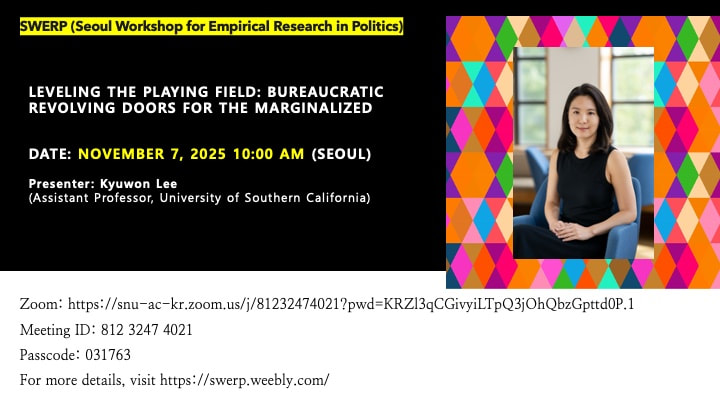
Leveling the Playing Field: Bureaucratic Revolving Doors for the Marginalized
Date: November 7, 2025 10:00 AM (Seoul)
Presenter: Kyuwon Lee, Assistant Professor, University of Southern California
Existing scholarship often portrays bureaucratic revolving doors as distorting government resource allocation and privileging large, well-organized interests. This paper challenges that view by focusing on revolving doors of mid-level career bureaucrats who constitute the vast majority of the federal workforce. I argue that these former bureaucrats can help marginalized businesses navigate complex regulations with their expertise, facilitating the participation of previously excluded firms in government processes. As a consequence, they may reduce inequalities between well-established and less-established firms. To test this claim, I examine U.S. federal contracting and assemble novel data on the career trajectories of more than 33,000 contracting officers across agencies. Using a difference-in-differences design on a firm–year panel from 2004–2024, I find that small firms inexperienced in federal contracting particularly yield meaningful increases in contract awards after hiring former contracting officers. Additional analyses suggest that these gains are driven by expertise but not by personal connections. These findings bring marginalized businesses to debates over appropriate revolving-door restrictions.
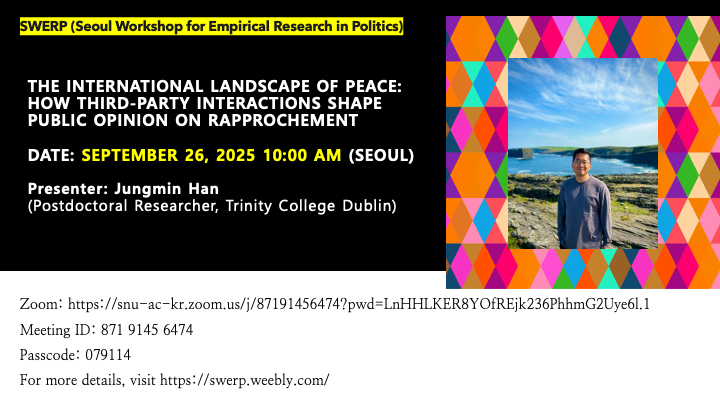
The International Landscape of Peace: How Third-Party Interactions Shape Public Opinion on Rapprochement
Date: September 26, 2025 10:00 AM (Seoul)
Presenter: Jungmin Han, Postdoctoral Researcher, Trinity College Dublin
Under what international contexts are citizens more likely to support peace with a foreign adversary? To explain public opinion on interstate peace, existing research has largely focused on factors within rivalry dyads, overlooking the influence of a broader international environment in which rivalries are situated. This study addresses this gap by introducing a novel model that explains how international interactions involving third-party states shape public perceptions of state actors. Model simulations suggest that interstate conflict involving third-party actors—such as between an ally and a rival or between an ally and a rival's ally—can heighten perceptions of inter-group confrontation, reinforcing the adversary's enemy image and increasing opposition to conciliatory policies. The theoretical claims are tested using both experimental and observational methods. The first study employs a survey experiment to assess how exposure to a news video clip of conflict or cooperation between allied and enemy states (e.g., China-Japan, North-South Korea) influences American attitudes toward China. The second study applies supervised machine learning to over one million tweets to examine how fluctuations in U.S.–North Korea relations between 2017 and 2018 shaped public sentiment in South Korea and Japan toward their respective rivals, North Korea and China. The findings of both studies indicate that exposure to third-party conflicts increases the likelihood that individuals perceive rival states more negatively and show stronger resistance to rapprochement. These results demonstrate that public opinion on interstate peace is both socially embedded, shaped not only by bilateral dynamics but also by broader patterns of interstate behavior.
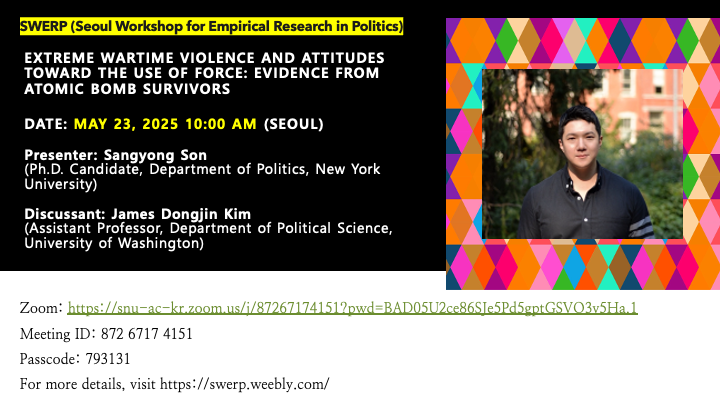
Extreme Wartime Violence and Attitudes Toward the Use of Force: Evidence from Atomic Bomb Survivors
Date: May 23, 2025 10:00 AM (Seoul)
Presenter: Sangyong Son, Ph.D. Candidate, Department of Politics, New York University
Discussant: James Dongjin Kim, Assistant Professor, Department of Political Science, University of Washington
Previous studies have examined how conventional wartime violence influences human attitudes toward the use of force. However, despite the frequent past and potential future use of excessively destructive weapons, no research has explored how extreme wartime violence shapes these attitudes. I argue that exposure to extreme wartime violence fosters anti-militarism. To test this argument, I leverage the natural experiment of the atomic bombings in Japanese cities and collect original data from Japanese and Korean atomic bomb survivors. I find that direct exposure to atomic bombings leads to a strong aversion to war and the instruments of war. However, the strength of such anti-militaristic preferences is conditional on external security threats. Although both Japanese and Korean atomic bomb survivors oppose the use and acquisition of nuclear weapons, Korean survivors express significantly weaker aversion to possessing an independent nuclear arsenal as a means of deterring imminent nuclear threats from North Korea.
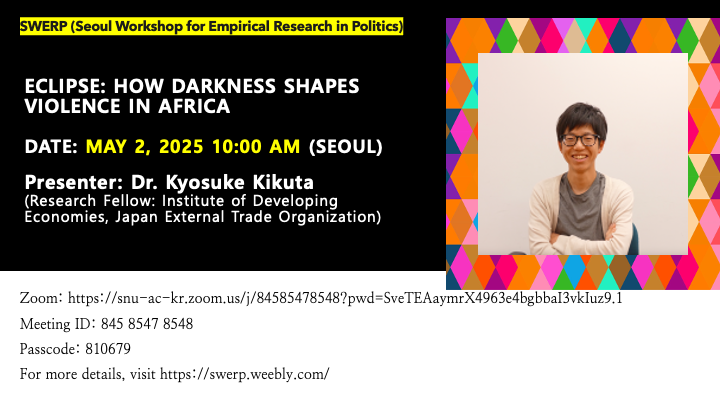
Eclipse: How Darkness Shapes Violence in Africa
Date: May 2, 2025 10:00 AM (Seoul)
Presenter: Dr. Kyosuke Kikuta, Research Fellow, Institute of Developing Economies, Japan External Trade Organization
Although darkness has long been associated with insecurity, the link remains speculative. I fill the gap by examining the effect of solar eclipses on violence. Expanding on psychological theories, I hypothesize that eclipse-induced darkness evokes fear, which in turn is misattributed to outgroups, thereby triggering violence. I contrast this argument with a tactical explanation, suggesting that darkness allows armed groups to secretly kill civilians. I test the "eclipse effect" by exploiting exogenous variations in the dates and locations of solar eclipses for 1997–2022 in Africa. The analysis indicates a spike in violence on the days of solar eclipses. To explore the mechanisms, I examine the initiators and original texts of violent events, weather conditions, ethnic folklore, and individual-level surveys. The analyses support the tactical rather than psychological explanation. These findings warn against assuming that "irrational" or "superstitious" African people overreacted to eclipses; armed groups rationally can use darkness for their tactical purposes.
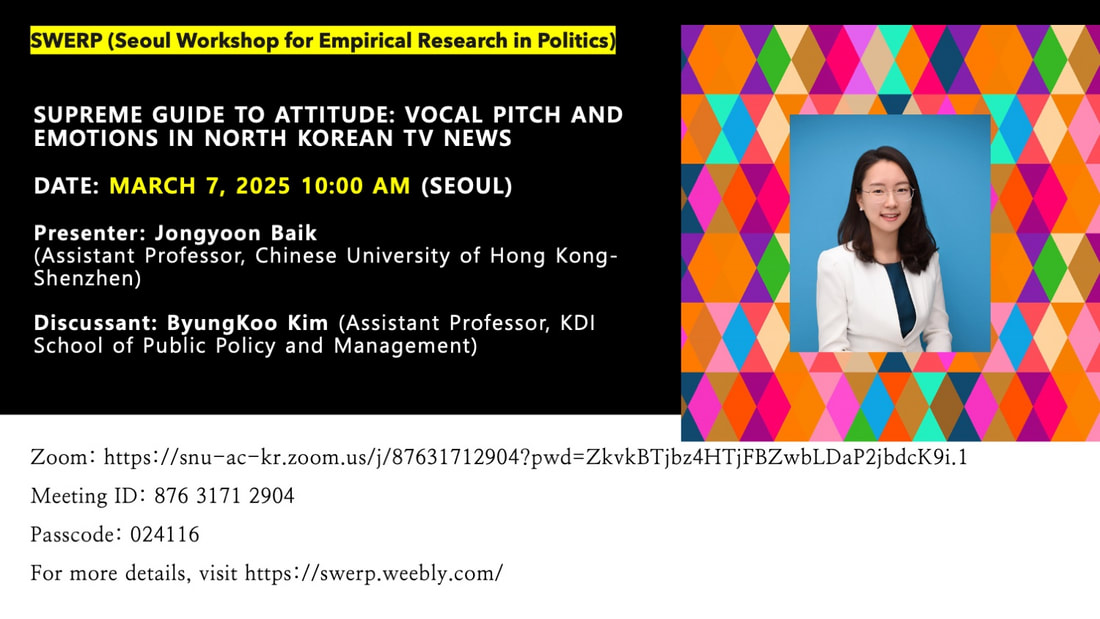
Supreme Guide to Attitude: Vocal Pitch and Emotions in North Korean TV News
Date: March 7, 2025 10:00 AM (Seoul)
Presenter: Jongyoon Baik, Assistant Professor, Chinese University of Hong Kong-Shenzhen
Discussant: ByungKoo Kim, Assistant Professor, KDI School of Public Policy and Management
What is the purpose of the excessively emotional delivery of North Korean TV news? We argue that an authoritarian regime employs emotional agenda-setting through such propaganda. Specifically, the regime demonstrates its desired reactions to certain political issues so that the public can mirror its preferences without engaging in rational thinking. We hypothesize that when the media highlights regime strength, covers foreign news, or delivers new information, it intensifies emotional propaganda to orchestrate public responses. To test our hypotheses, we build an original video archive from daily broadcasts on North Korean Central Television, namely Bodo (News Reports), aired from 2016 to 2023. We operationalize the data with an audio-as-data approach in three steps: transcribing and segmenting the video clips with Automatic Speech Recognition, calculating vocal pitch as measures of emotional intensity, and identifying propaganda contents with topic modeling and dictionary methods. Our preliminary results show that topics related to hard power and foreign adversaries are strongly associated with high vocal pitch.
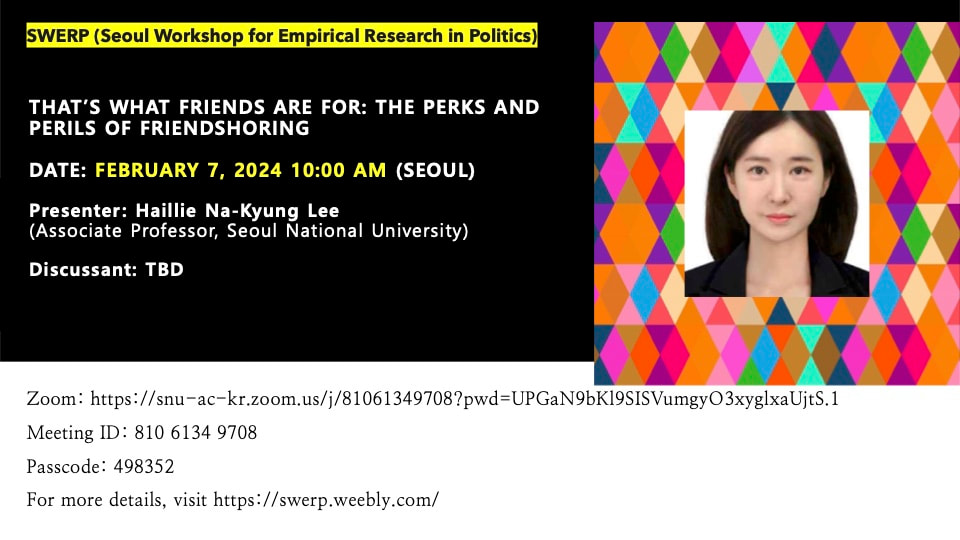
That's What Friends Are For: The Perks and Perils of Friendshoring
Date: February 7, 2024 10:00 AM (Seoul)
Presenter: Haillie Na-Kyung Lee, Associate Professor, Seoul National University
Recent geopolitical developments, such as the ongoing conflict between Russia and Ukraine and the escalating tensions between the United States and China, have fundamentally altered the landscape of globalization. The increasing geopolitical divide has spurred concerns among the U.S. and its allies that locating supply chains in politically misaligned countries could expose them to significant disruptions. While the previous era of globalization prioritized economic efficiency and gains through the offshoring of companies, these tensions have brought the concept of "friend-shoring" to the forefront—relocating economic activities to nations with aligned political interests to enhance the security and management of supply chains. However, there remains an important gap in our understanding: under what conditions can friend-shoring be effective? This book seeks to address this question by examining the interplay between regime type and the effectiveness of friend-shoring strategies. I argue that while friend-shoring offers strategic advantages, its effectiveness varies significantly based on the host regime type. In autocratic regimes, where decision-making is centralized and less encumbered by competing interests, the benefits of friend-shoring are more easily realized. Autocracies can swiftly implement policies that favor foreign investment, enabling aligned nations to secure economic advantages. Conversely, in democracies, institutional checks and balances that protect against arbitrary decision-making may also impede the quick implementation of policies that favor specific foreign investments, even when strong political ties exist. Thus, the very features of democratic governance—such as opposition parties, regional governments, and public opinion—can limit the effectiveness of friend-shoring by complicating or delaying necessary policy adjustments. I use project-level data from South Korean embassies and World Bank to test this claim.
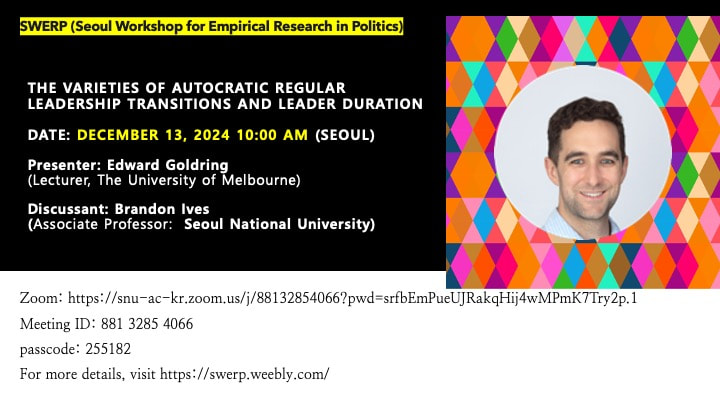
The Varieties of Autocratic Regular Leadership Transitions and Leader Duration
Date: December 13, 2024 10:00 AM (Seoul)
Presenter: Edward Goldring, Lecturer, The University of Melbourne
Discussant: Brandon Ives, Associate Professor, Seoul National University
Regular leadership transitions (RLTs) are crucial to the endurance of autocratic regimes. Prior work treats RLTs as a singular phenomenon, but there are qualitative differences among them. We offer an original typology of RLTs based on variation in two dimensions: the method of the incumbent's departure, and the main driving force behind the successor's identity. We theorize that one of these RLTs, an 'internal imposition'—when the predecessor departs voluntarily, and elites are the successor's main backers—is systematically associated with shorter leader tenure. These circumstances constrain the new dictator from consolidating power and circumventing rules surrounding succession. We find support for the argument from a sample of autocrats in Asia between 1946 and 2019, using novel data on the varieties of RLTs. The article contributes to research on comparative autocracy by demonstrating the utility of conceptualizing and analyzing the systematic effects of the varieties of RLTs.
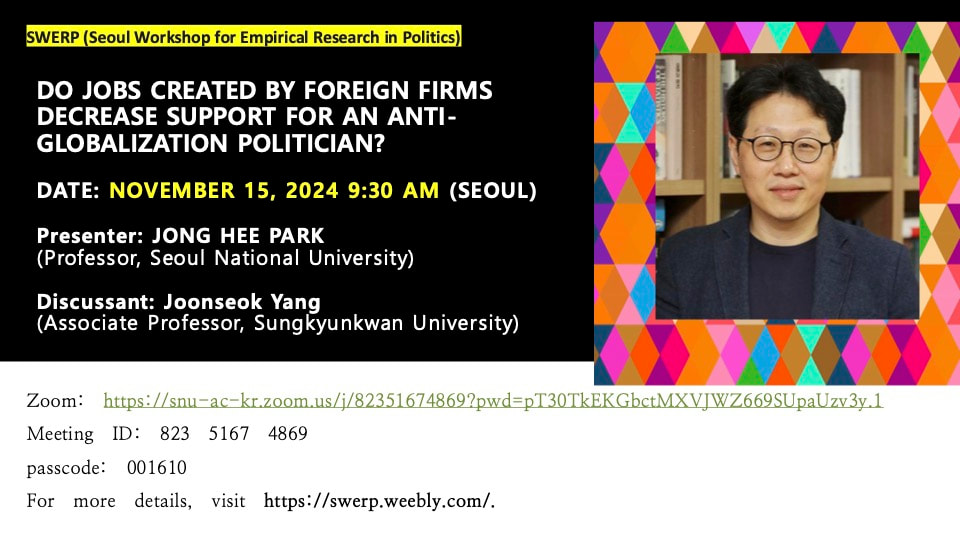
Do Jobs Created by Foreign Firms Decrease Support for an Anti-Globalization Politician?
Date: November 15, 2024 9:30 AM (Seoul)
Presenter: Jong Hee Park, Professor, Seoul National University
Discussant: Joonseok Yang, Associate Professor, Sungkyunkwan University
Available upon request.
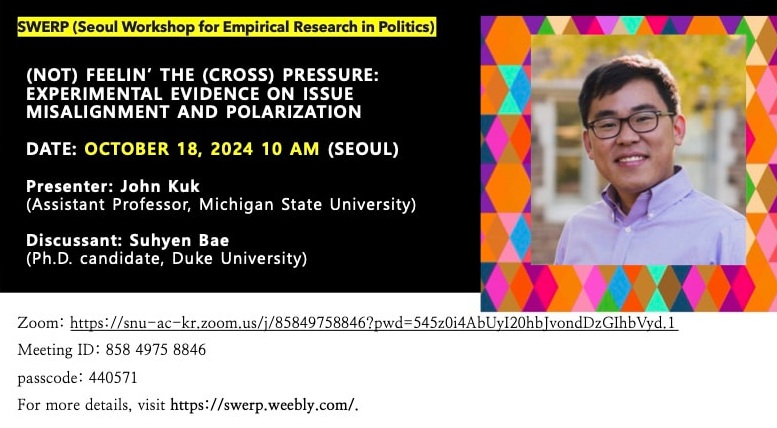
(Not) Feelin' the (Cross) Pressure: Experimental Evidence on Issue Misalignment and Polarization
Date: October 18, 2024 10:00 AM (Seoul)
Presenter: John Kuk, Assistant Professor, Michigan State University
Discussant: Suhyen Bae, Ph.D. candidate, Duke University
Over the past decade, police reform has emerged as one of the most contentious issues in American politics. Debates over policing policy have reified along partisan cleavages, contributing to the apparent polarization of politics. This article shows that while attitudes on policing are indeed polarized along party lines, a meaningful percentage of cross-pressured voters hold issue preferences that diverge from the majority position in their party. We argue that a false consensus effect leads people to believe that their attitudes are more in line with co-partisans than they actually are, heightening perceived partisan polarization. Using a representative survey of American adults, we show that most cross-pressured individuals are unaware of the extent to which their positions diverge from their co-partisans. We then present results from an experiment showing that informing individuals about their cross-pressures causes a significant reduction in attachment to their own party, and improves attitudes towards the opposing party. Bringing attention to inconsistencies between a person's policy preferences and their partisan attachment could therefore reduce partisan polarization.